

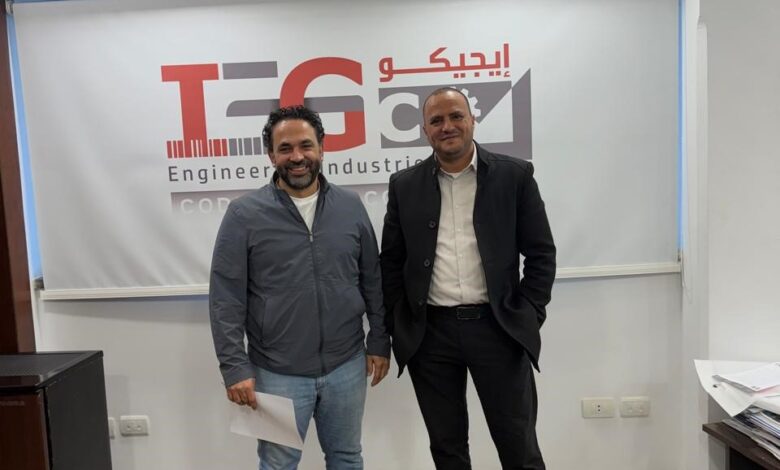
The Integrated Engineering Group Company, known as IEGCO, which specializes in manufacturing variable data printing machines for consumer goods, began operations in 2010 as a small workshop with capital of no more than EGP 5,000
Nearly 15 years later, the company has evolved into an industrial player producing machines for printing barcodes, prices, logos, and production and expiration dates, with a growing presence in both local and African markets
This transformation followed the company’s success in manufacturing printing machines for three global companies inside Egypt, alongside the start of exports to several foreign markets, as part of a strategy aimed at localizing an industry that has traditionally relied heavily on imports
The Idea and Early Challenges
The idea behind establishing IEGCO dates back to two friends who studied engineering and began, during their university years, thinking about launching an industrial project that would meet a real market need
After graduating in 2006, the founders spent about four years searching for a viable idea, having observed the near-total reliance of the Egyptian market on imported barcode and product pricing machines
In 2010, the two partners began setting up a small workshop in the Basateen district of Cairo, with limited resources and modest capital secured through borrowing
The initial focus was on manufacturing machines linked to essential production needs, such as printing variable data on consumer goods
Local Manufacturing and Building Trust
Khaled Ibrahim, Chief Executive Officer and co-founder of IEGCO, said the company relied in its early stages on direct marketing efforts, communicating with factories to convince them to adopt locally manufactured machines in a market that traditionally favored imported products
He explained that, in some cases, the company priced its products at relatively low levels, prioritizing proof of quality and trust-building over quick profits, a strategy that later supported expansion and a growing client base
Ibrahim noted that Egypt’s imports of variable data printing machines are estimated at around $500 million annually, in addition to approximately $2 billion worth of inks, consumables, and spare parts
This represented a significant opportunity to localize the industry and reduce dependence on external suppliers
He added that IEGCO currently works with a number of major factories across sectors including cement, pharmaceuticals, cosmetics, food industries, textiles, and detergents, supplying both laser and ink printing machines
Product and Market Expansion
In 2015, the company launched its first large-scale machines designed for printing barcodes and expiration dates on cement and flour bags, as part of a plan to expand its product range
Ibrahim said IEGCO specializes in variable data printing machines and currently exports to Morocco, Nigeria, and several other African countries, with plans to enter additional markets
For his part, Hamdy Abd El Fattah, General Manager and co-founder of IEGCO, said the company now accounts for around 90% of variable data printing machine supplies to cement factories, achieved over a decade since introducing these machines to the market
Local Manufacturing With Global Partnerships
Abd El Fattah added that IEGCO currently manufactures products for three global companies inside Egypt, including securing a manufacturing license in 2019 from US-based HP, making it one of only seven companies worldwide to obtain such a license, and the first in Africa and the Middle East to produce HP machines in Egypt under the “Made in Egypt” label
He noted that the company later obtained manufacturing licenses from two other firms, one British and the other Japanese, after building a strong track record of cooperation and trust with international partners
Exports and Growth Through Crises
IEGCO began exporting to foreign markets in 2018, while 2020 saw notable growth rates amid disruptions to global supply chains during the Covid-19 pandemic, which boosted demand for locally produced alternatives
In 2022, the company continued its domestic and regional expansion by increasing the number of distributors and strengthening its presence in external markets, while targeting further growth in the coming years